
Leading Smart City Technology Vendors in Saudi Arabia
BLOGS
7/27/2026
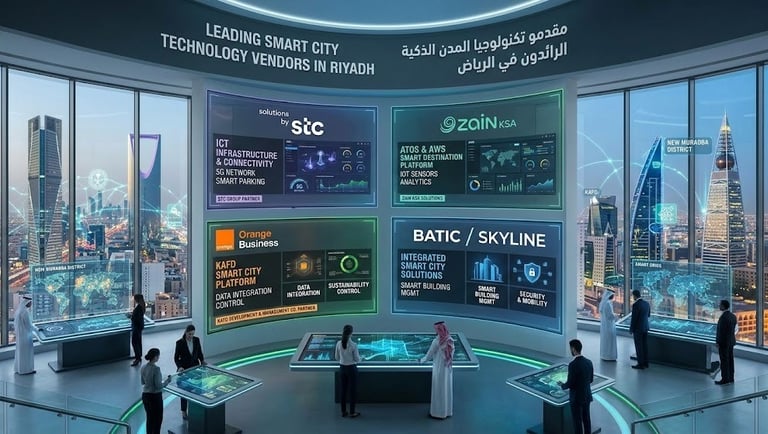
Saudi Arabia is in the middle of one of the most ambitious urban transformation programs in modern history. Across the Kingdom, city planners, government ministries, and enterprise developers are under pressure to deliver intelligent infrastructure at a scale and speed that has no real precedent. Vision 2030 has moved from policy document to active construction, and the technology decisions being made today—about connectivity, data management, energy systems, and urban automation—will shape how Saudi cities function for the next several decades.
The challenge is that "smart city" has become an overloaded term. Vendors ranging from niche IoT startups to global ICT conglomerates all claim to offer smart city solutions, but the actual scope of what each delivers varies enormously. A municipality evaluating vendors for a waste management digitalization project has fundamentally different requirements from a giga-project developer building an entirely new cognitive urban ecosystem from scratch.
This article profiles five of the most significant smart city technology vendors currently operating in Saudi Arabia, examining what each one actually does, where they fit best, and what differentiates them from their competitors.
1. Tonomus: Building Cognitive Cities from the Ground Up
Tonomus occupies a category of its own. As the cognitive technology and digital infrastructure subsidiary of NEOM, it is not simply a vendor deploying smart city products into an existing environment—it is architecting the foundational infrastructure for cities that have no legacy systems to work around. Where most smart city vendors are helping old cities become smarter, Tonomus is building new cities to be cognitive from day one.
What It Delivers?
The company's core offering centers on cognitive digital twin platforms that simulate urban systems in real time, enabling predictive rather than reactive city management. Its infrastructure stack includes hyperscale cloud and edge computing, metaverse-driven urban planning APIs, and autonomous city management systems that continuously ingest operational data to anticipate problems before they occur. The entire infrastructure is designed to run on 100% renewable energy and is engineered specifically for the demands of the Saudi desert environment—heat management, dust resistance, and energy efficiency are built into the architecture rather than added as afterthoughts.
Who Should Pay Attention?
Tonomus is most relevant to mega-project developers and government entities involved in Vision 2030 flagship initiatives. Its mandate is explicitly to build indigenous technology infrastructure for the Kingdom and the MENA region, so its pipeline is tied closely to NEOM's expansion and the broader national transformation agenda. Enterprise partners looking to integrate with next-generation city platforms will find Tonomus worth engaging early, given the scale of what is being built.
2. iot squared: The Sovereign IoT Enabler
For organizations working within existing Saudi municipalities—rather than greenfield mega-projects—iot squared is arguably the most strategically positioned IoT platform vendor in the Kingdom. The company was established as a joint venture with direct backing from stc Group, the national telecommunications operator, and PIF, the sovereign wealth fund. That ownership structure is not just a funding advantage; it translates into deep integration with national telecom infrastructure and a level of government trust that international vendors typically spend years trying to establish.
What It Delivers?
iot squared provides end-to-end IoT solutions covering smart waste management, intelligent street lighting, connected fleet and mobility tracking, and industrial sensor deployment for utility monitoring. Its platform operates as IoT-as-a-Service (PaaS), with integrated data analytics that allow municipalities and enterprise clients to extract operational intelligence from their sensor networks without building in-house data science capabilities. The platform is also designed from the ground up to comply with Saudi data sovereignty laws and the frameworks set by the National Cybersecurity Authority (NCA).
Who Should Pay Attention?
Urban planners, municipal governments, logistics companies, and manufacturing enterprises operating within Saudi Arabia are the natural audience. For any organization that needs to deploy IoT infrastructure at city scale while maintaining full compliance with local regulatory requirements, iot squared eliminates significant procurement and compliance complexity. Its stc Group partnership also means connectivity agreements are more straightforward to negotiate than they would be with a vendor that has no native telecom relationships.
3. Siemens Saudi Arabia: Operational Technology Meets Digital Intelligence
Siemens has been building critical physical infrastructure in Saudi Arabia for decades, and the company's smart city position is built on that operational foundation. While newer entrants focus primarily on data platforms and software layers, Siemens' competitive advantage lies in its ability to bridge operational technology (OT)—the hardware that runs power grids, HVAC systems, and industrial processes—with modern digital IT systems. That convergence is exactly where many urban digitalization projects stall.
What It Delivers?
On the energy and utilities side, Siemens deploys smart grid automation systems capable of integrating solar and wind renewable sources, along with AI-driven microgrid controls that optimize power distribution at the district or building level. For commercial real estate and public buildings, its Desigo CC platform provides integrated building management, consolidating HVAC, fire safety, access control, and energy monitoring into a single operational interface. The MindSphere industrial IoT platform extends this to utility tracking across urban infrastructure. Siemens also provides AI-driven traffic management solutions relevant for both new developments and existing urban corridors.
Siemens maintains local manufacturing facilities and technology training centers for Saudi nationals in Riyadh, Jeddah, and Al Khobar—a localization commitment that aligns with Vision 2030's national employment targets.
Who Should Pay Attention?
Commercial real estate developers, national utility providers, and municipal transit authorities with existing physical infrastructure that needs to be modernized and digitized will find Siemens most relevant. Organizations that have previously struggled to make new software platforms talk to legacy hardware—pumping stations, substations, building systems—will benefit from Siemens' OT expertise, which most pure-software vendors cannot replicate.
4. Cisco Systems Saudi Arabia: The Secure Network Backbone
No smart city platform works without a reliable, secure, and interoperable network layer underneath it. Cisco's role in Saudi Arabia's smart city landscape is precisely that: providing the networking and cybersecurity infrastructure that allows disparate systems—from traffic sensors to public safety cameras to utility meters—to communicate securely and share data in a usable format.
What It Delivers?
Cisco's most strategically significant product in this context is Cisco Kinetic for Cities, a data aggregation and normalization platform that pulls in data streams from multi-vendor sensors across a city and standardizes them into a single, coherent urban operations dashboard. This addresses one of the most common problems in smart city deployments: cities end up with dozens of disconnected systems, each with its own data format and management interface, making integrated decision-making nearly impossible. Kinetic removes that fragmentation without requiring cities to standardize on a single hardware vendor.
Beyond the data layer, Cisco provides high-capacity 5G and Wi-Fi 6E urban mesh networking for public spaces and critical infrastructure, and zero-trust network access (ZTNA) architecture designed to meet the NCA's strict compliance standards. Its Riyadh regional headquarters includes localized Saudi data centers and engineering teams specifically configured for Saudi regulatory requirements.
Who Should Pay Attention?
Telecommunications providers, smart city IT departments, and large public infrastructure operators—particularly those managing multi-vendor environments—are Cisco's primary audience. For city planners concerned about vendor lock-in, Cisco Kinetic is worth evaluating specifically because it is designed to work across vendor ecosystems rather than enforce proprietary dependency.
5. Huawei Saudi Arabia: End-to-End Urban ICT at Scale
Huawei's approach to smart cities in Saudi Arabia is comprehensive by design. The company offers what it calls "City Intelligent Twins" architectures—integrated urban intelligence platforms that combine physical 5G infrastructure with AI-powered analytics and a centralized Intelligent Operation Center (IOC) for real-time city monitoring and emergency coordination.
What It Delivers?
The IOC is the command-and-control centerpiece of Huawei's smart city offering, providing government agencies and public safety departments with real-time visibility across traffic, utilities, environmental conditions, and emergency response systems. AI-powered computer vision is embedded directly into this system, enabling automated analysis of public safety footage and traffic flow without requiring manual review at scale. On the connectivity side, Huawei provides 5G-enabled infrastructure for autonomous vehicle operations and high-performance municipal cloud computing through its localized Saudi Arabia Cloud Region—ensuring that sensitive city data remains within the Kingdom's borders.
Arabic-language support is natively integrated into Huawei's AI models, which matters practically for public-facing applications and for government operators working in Arabic-language operational environments.
Who Should Pay Attention?
Government ministries, public safety agencies, telecommunications operators, and enterprise cloud users represent Huawei's core market. Its end-to-end stack—covering hardware, connectivity, cloud, and AI—makes it particularly well-suited for large municipalities or government agencies that prefer a consolidated vendor relationship over managing multiple specialized providers.
How to Choose the Right Vendor for Your Requirements?
The vendors profiled here are not direct competitors in the traditional sense—they serve different layers of the smart city technology stack and often operate on the same projects simultaneously. The right starting point is a clear definition of your organization's specific mandate.
If you are involved in a greenfield mega-project with no legacy infrastructure constraints, Tonomus is the logical first conversation, given its exclusive mandate to build cognitive city architecture for Saudi Arabia's flagship developments. For existing municipalities deploying IoT infrastructure with local compliance as a non-negotiable, iot squared's sovereign backing and regulatory alignment are difficult to replicate.
Organizations modernizing physical infrastructure—power grids, building systems, utilities—should evaluate Siemens before exploring purely software-led alternatives, because OT-IT convergence is genuinely difficult and Siemens' operational depth in Saudi Arabia is substantial. For projects where multi-vendor interoperability and cybersecurity are primary concerns, Cisco's network and data normalization capabilities deserve serious consideration, particularly for IT departments wary of fragmented system management. Huawei is the strongest option for government clients seeking a consolidated ICT stack with localized cloud infrastructure and Arabic-language AI capabilities already in production.
Saudi Arabia's urban transformation is well past the planning stage. The vendors building this infrastructure are operating at real scale, and the decisions being made by procurement teams, city planners, and enterprise partners today will have a long operational horizon. Choosing on price alone, or on brand recognition without reference to the specific technology requirements of your project, is a risk that the complexity of these systems does not forgive easily.
© 2026. All rights reserved.
Contacts:
info@karobardirectory.com